Hero With a Thousand Faces Read the Preface to the 1949 Edition and Myths and Dreams
 Cover of the first edition | |
| Author | Joseph Campbell |
|---|---|
| Country | United States |
| Language | English language |
| Field of study | Mythology |
| Published |
|
| Media blazon | Print (hardcover and paperback) |
| ISBN | 978-1-57731-593-iii |
| Dewey Decimal | 201/.3 22 |
| LC Class | BL313 .C28 2008 |
The Hero with a Thousand Faces (first published in 1949) is a work of comparative mythology by Joseph Campbell, in which the author discusses his theory of the mythological construction of the journey of the archetypal hero plant in world myths.
Since the publication of The Hero with a Thousand Faces, Campbell's theory has been consciously applied by a wide diverseness of modern writers and artists. Filmmaker George Lucas acknowledged Campbell'due south theory in mythology, and its influence on the Star Wars films.[one]
The Joseph Campbell Foundation and New World Library issued a new edition of The Hero with a 1000 Faces in July 2008 as part of the Collected Works of Joseph Campbell series of books, sound and video recordings. In 2011, Fourth dimension placed the volume in its list of the 100 best and most influential books written in English since the magazine was founded in 1923.[2]
Summary [edit]
Campbell explores the theory that mythological narratives frequently share a fundamental structure. The similarities of these myths brought Campbell to write his book in which he details the structure of the monomyth. He calls the motif of the archetypal narrative, "the hero's run a risk". In a well-known passage from the introduction to The Hero with a Thousand Faces, Campbell summarizes the monomyth:
A hero ventures forth from the world of mutual 24-hour interval into a region of supernatural wonder: fabled forces are there encountered and a decisive victory is won: the hero comes back from this mysterious risk with the power to bestow boons on his boyfriend human being.[three]
In laying out the monomyth, Campbell describes a number of stages or steps forth this journey. "The hero'southward run a risk" begins in the ordinary earth. He must depart from the ordinary world, when he receives a call to adventure. With the help of a mentor, the hero volition cantankerous a guarded threshold, leading him to a supernatural world, where familiar laws and order practice non apply. There, the hero will commence on a road of trials, where he is tested forth the way. The archetypal hero is sometimes assisted past allies. As the hero faces the ordeal, he encounters the greatest claiming of the journeying. Upon rising to the claiming, the hero volition receive a advantage, or boon. Campbell's theory of the monomyth continues with the inclusion of a metaphorical death and resurrection. The hero must and so decide to return with this benefaction to the ordinary earth. The hero and then faces more trials on the road dorsum. Upon the hero'due south return, the boon or gift may be used to improve the hero's ordinary earth, in what Campbell calls, the application of the boon.
While many myths do seem to follow the outline of Campbell's monomyth, there is some variance in the inclusion and sequence of some of the stages. Yet, there is an affluence of literature and folklore that follows the motif of the archetypal narrative, paralleling the more general steps of "Departure" (sometimes called Separation), "Initiation", and "Return". "Departure" deals with the hero venturing along on the quest, including the phone call to gamble. "Initiation" refers to the hero's adventures that will test him along the mode. The terminal part of the monomyth is the "Return", which follows the hero'southward journey home.[ commendation needed ]
Campbell studied religious, spiritual, mythological and literary classics including the stories of Osiris, Prometheus, the Buddha, Moses, Mohammed, and Jesus. The book cites the similarities of the stories, and references them as he breaks down the structure of the monomyth.
The book includes a word of "the hero's journey" by using the Freudian concepts popular in the 1940s and 1950s. Campbell'southward theory incorporates a mixture of Jungian archetypes, unconscious forces, and Arnold van Gennep'due south structuring of rites of passage rituals to provide some illumination.[iv] "The hero'due south journey" continues to influence artists and intellectuals in contemporary arts and culture, suggesting a bones usefulness for Campbell'south insights beyond mid-20th century forms of analysis.
Groundwork [edit]
Campbell used the work of early-20th-century theorists to develop his model of the hero (see also structuralism), including Freud (peculiarly the Oedipus complex), Carl Jung (archetypal figures and the collective unconscious), and Arnold Van Gennep. Van Gennep contributed the concept of there beingness 3 stages of The Rites of Passage. Campbell translated this into Separation , Initiation and Return . He also looked to the work of psychologist Otto Rank and ethnographers James George Frazer and Franz Boas.
Campbell was a noted scholar of James Joyce, having co-authored A Skeleton Key to Finnegans Wake with Henry Morton Robinson. Campbell borrowed the term monomyth from Joyce's Finnegans Wake. In improver, Joyce'south Ulysses was also highly influential in the structuring of the archetypal motif.
Publishing history [edit]
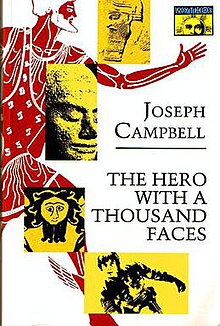
The volume was originally published by the Bollingen Foundation through Pantheon Press as the seventeenth title in the Bollingen Series. This serial was taken over by Princeton University Press, who published the book through 2006. Originally issued in 1949 and revised by Campbell in 1968, The Hero with a Thousand Faces has been reprinted a number of times. Reprints issued after the release of Star Wars in 1977 used the image of Marking Hamill as Luke Skywalker on the cover. Princeton University Press issued a commemorative printing of the 2d edition in 2004 on the occasion of the joint centennial of Campbell'due south nascency and the Press's founding with an added foreword past Clarissa Pinkola Estés.
A third edition, compiled by the Joseph Campbell Foundation and published past New Globe Library, was released as the twelfth title in the Nerveless Works of Joseph Campbell series in July 2008.
The Hero with a Thousand Faces has been translated into over twenty languages, including Castilian, Portuguese, French, German, Italian, Japanese, Korean, Chinese (simplified and traditional), Turkish, Dutch, Greek, Danish, Norwegian, Persian, Polish, Romanian, Czech, Croatian, Serbian, Slovenian, Russian, Hungarian, Bulgarian and Hebrew, and has sold well over a 1000000 copies worldwide.[5]
Artists influenced by the work [edit]
In Pathways to Bliss: Mythology and Personal Transformation, a book drawn from Campbell'due south late lectures and workshops, he says about artists and the monomyth:
Artists are magical helpers. Evoking symbols and motifs that connect u.s.a. to our deeper selves, they can help usa along the heroic journeying of our own lives. [...]
The artist is meant to put the objects of this globe together in such a mode that through them you will feel that low-cal, that radiance which is the light of our consciousness and which all things both hide and, when properly looked upon, reveal. The hero'south journey is i of the universal patterns through which that radiance shows brightly. What I think is that a good life is one hero journey after another. Over and once more, y'all are called to the realm of adventure, you are called to new horizons. Each time, there is the same trouble: exercise I dare? And so if y'all practice cartel, the dangers are in that location, and the assist besides, and the fulfillment or the fiasco. At that place'southward e'er the possibility of a fiasco.
But there'south also the possibility of elation.
—Joseph Campbell, [6]
Influences on artists [edit]
The Hero with a Thousand Faces has influenced a number of artists, filmmakers, musicians, producers and poets. Some of these figures include Bob Dylan, George Lucas, Marker Burnett and Jim Morrison. Additionally, Mickey Hart, Bob Weir, and Jerry Garcia of the Grateful Expressionless had long noted Campbell's influence and participated in a seminar with Campbell in 1986, entitled "From Ritual to Rapture".[7]
In film [edit]
Stanley Kubrick introduced Arthur C. Clarke to the book during the writing of 2001: A Space Odyssey.[8]
George Lucas' deliberate apply of Campbell'due south theory of the monomyth in the making of the Star Wars movies is well documented. On the DVD release of the famous colloquy betwixt Campbell and Pecker Moyers, filmed at Lucas' Skywalker Ranch and broadcast in 1988 on PBS equally The Power of Myth, Campbell and Moyers discussed Lucas'due south use of The Hero with a Thousand Faces in making his films.[9] Lucas himself discussed how Campbell's work afflicted his approach to storytelling and film-making.[10]
In games [edit]
Jenova Chen, pb designer at thatgamecompany, also cites The Hero'due south Journey as the primary inspiration for the PlayStation 3 game Journeying (2012).[11]
Mark Rosewater, head designer of the Magic: The Gathering trading menu game, cites The Hero's Journeying as a major inspiration for "The Weatherlight Saga", an epic story arc that went from 1997 to 2001, and spanned multiple card sets, comic books, and novels.[ citation needed ]
In literature [edit]
Christopher Vogler, a Hollywood moving picture producer and writer, wrote a memo for Disney Studios on the use of The Hero with a Thousand Faces as a guide for scriptwriters; this memo influenced the creation of such films as Dazzler and the Animate being (1991), Aladdin (1992), and The King of beasts Rex (1994). Vogler later expanded the memo and published it as the book The Writer'due south Journeying: Mythic Structure For Writers, which became the inspiration for a number of successful Hollywood films and is believed to have been used in the development of the Matrix series.
Novelist Richard Adams acknowledges a debt to Campbell's work, and specifically to the concept of the monomyth.[12] In his best known piece of work, Watership Down, Adams uses extracts from The Hero with a Thousand Faces every bit chapter epigrams.[13]
Writer Neil Gaiman, whose piece of work is often seen as exemplifying the monomyth construction,[xiv] says that he started The Hero with a Thousand Faces just refused to finish it:
"I think I got nigh half fashion through The Hero with a K Faces and found myself thinking if this is true—I don't want to know. I really would rather not know this stuff. I'd rather do it because it'south true and because I accidentally wind upwards creating something that falls into this pattern than be told what the pattern is."[15]
Many scholars and reviewers have noted how closely J. K. Rowling'due south popular Harry Potter books hewed to the monomyth schema.[16]
In television [edit]
Dan Harmon, the creator of the Tv set show Community, has stated that he has used the monomyth as inspiration for his work.[17]
The sixth and terminal season of Lost recognizes Campbell'south theories on the hero. During one of the bonus features, the makers of the series discuss the journey of the main characters and how each is a hero in their own style. Earlier each little segment of this particular feature, they quote Campbell and and so expound on that particular quote by discussing the diverse characters.
See likewise [edit]
- The Gold Bough by James George Frazer
- The Atomic number 26 Dream past Norman Spinrad
- The Vii Basic Plots by Christopher Booker
- Vladimir Propp
- Aarne–Thompson classification systems
- Bildungsroman
- The Myth of the Nascency of the Hero by Otto Rank
References [edit]
- ^ Joseph Campbell, The Hero's Journey: Joseph Campbell on His Life and Work, tertiary edition, Phil Cousineau, editor. Novato, California: New World Library, 2003, pp. 186-187.
- ^ "Ideas: The Hero with a Thousand Faces by Joseph Campbell". Time. August xxx, 2011.
- ^ Joseph Campbell. The Hero with a Thousand Faces. Princeton: Princeton University Press, 1968, p. 30 / Novato, California: New Globe Library, 2008, p. 23.
- ^ Since the late 1960s, with the introduction of post-structuralism, theories such as the monomyth (to the extent they are based in structuralism) have lost ground in the academic world. Nonetheless, the resonance of this theory and of Campbell's schema remains; every year, The Hero with a Thousand Faces is used as a text-volume in thousands of university courses worldwide. Source: Joseph Campbell Foundation website.
- ^ The Complete Works of Joseph Campbell data base on the Joseph Campbell Foundation website, accessed July two, 2010.
- ^ Pathways to Bliss: Mythology and Personal Transformation, Edited by David Kudler. Novato, California: New World Library, 2004, pp. 132, 133.
- ^ Stephen Larsen and Robin Larsen, Joseph Campbell: A Burn in the Mind, p. 540.
- ^ "The Kubrick Site: Clarke's 2001 Diary (excerpts)". visual-memory.co.uk . Retrieved March 2, 2015.
- ^ "Joseph Campbell and the Power of Myth - Season 1, Episode 1: The Hero'due south Chance - Idiot box.com". Tv set.com. CBS Interactive. Retrieved March ii, 2015.
- ^ Joseph Campbell, The Hero'south Journey, loc. cit.
- ^ Kevin O'Hannessian, GAME DESIGNER JENOVA CHEN ON THE Art BEHIND HIS "JOURNEY"; CoCreate Magazine
- ^ Bridgman, Joan (Baronial 2000). "Richard Adams at Eighty". The Contemporary Review (The Contemporary Review Company Express) 277.1615: 108. ISSN 0010-7565.
- ^ Richard Adams, Watership Down. Scribner, 2005, p. 225. ISBN 978-0-7432-7770-9
- ^ Come across Stephen Rauch, Neil Gaiman'south The Sandman and Joseph Campbell: In Search of the Modernistic Myth, Wildside Press, 2003
- ^ "Myth, Magic, and the Mind of Neil Gaiman - Wild River Review". wildriverreview.com . Retrieved March two, 2015.
- ^ Sharon Black, "The Magic of Harry Potter: Symbols and Heroes of Fantasy," Children'due south Literature in Education, Springer Netherlands, Book 34, Number 3 / September, 2003 [ expressionless link ] , pp. 237–247, ISSN 0045-6713; Patrick Shannon, "Harry Potter as Classic Myth"; Deborah De Rosa, "Wizardly Challenges to, and Affirmations of the Initiation Image in Harry Potter," Disquisitional Perspectives on Harry Potter, Elizabeth Heileman, ed. Routledge, 2002, pp 163–183—at that place are numerous similar references.
- ^ A Sense of Community: Essays on the Tv set Serial and Its Fandom. (McFarland, 2014) p. 24. ISBN 1476615713
Bibliography [edit]
- Campbell, Joseph. The Hero'southward Journeying: Joseph Campbell on His Life and Work. Edited and with an Introduction past Phil Cousineau. Foreword by Stuart 50. Chocolate-brown, Executive Editor. New York: Harper and Row, 1990.
- Campbell, Joseph and Henry Morton Robinson. A Skeleton Primal to Finnegans Wake, 1944.
- Campbell, Joseph. The Hero with a Yard Faces. 1st edition, Bollingen Foundation, 1949. 2nd edition, Princeton Academy Press. 3rd edition, New World Library, 2008.
- Campbell, Joseph. Pathways to Bliss: Mythology and Personal Transformation. Edited by David Kudler. Novato, California: New World Library, 2004.
- Ford, Clyde W. The Hero with an African Face. New York: Bantam, 2000.
- Henderson, Mary. Star Wars: The Magic of Myth. Companion volume to the exhibition at the National Air and Space Museum of the Smithsonian Institution. New York: Bantam, 1997.
- Larsen, Stephen and Robin Larsen. Joseph Campbell: A Fire in the Heed. Rochester, Vermont: Inner Traditions, 2002.
- Manganaro, Marc. Myth, Rhetoric, and the Vocalism of Authority: A Critique of Frazer, Eliot, Frye, and Campbell. New Haven: Yale, 1992.
- Moyers, Bill and Joseph Campbell. The Ability of Myth. Ballast: Reissue edition, 1991. ISBN 0-385-41886-8
- Pearson, Ballad and Katherine Pope. The Female Hero in American and British Literature. New York: R.R. Bowker, 1981.
- Vogler, Christopher. The Author's Journeying: Mythic Structure For Writers. Studio Metropolis, CA: Michael Wiese Productions, 1998.
Further reading [edit]
- Leeming, David Adams (1998) [1973]. Mythology; Journey of the Hero. Oxford University Press.
External links [edit]
- Information on the 2008 third edition from the Joseph Campbell Foundation
- Monomyth from UC Berkeley (archived)
angelesthestaters.blogspot.com
Source: https://en.wikipedia.org/wiki/The_Hero_with_a_Thousand_Faces
0 Response to "Hero With a Thousand Faces Read the Preface to the 1949 Edition and Myths and Dreams"
Enviar um comentário