What Was the Importance of Art Literature Poetry in Bedouin Society Ap World History
BEDOUINS

Bedouins are Arabs and desert nomads who hail from and proceed to live primarily in the Arabian peninsula and the Heart East and Due north Africa. They the accept traditionally lived in the barren steppe regions along the margins of pelting-fed tillage. They often occupy areas that receive less than 5 centimeters of rain a year, sometimes relying on pastures nourished by morning dew rather than pelting to provide water for their animals.
Bedouins regard themselves as true Arabs and the "heirs of glory." They are found generally in Jordan, Republic of iraq, Saudi Arabia, Republic of yemen, Oman and Egypt. Bedouins are objects of romance and associated with the idea of freedom for many Arabs. But there life is not like shooting fish in a barrel. Wilfred Thesinger described the Bedouin'due south life equally "hard and merciless...always hungry and usually thirsty."
Bedouin means "desert people." The term Bedouin is an anglicization of the Arabic word "bedu". It has traditionally been used to differentiate between nomads who made a living by raising livestock (the Bedouins) and those who worked on farms or lived in towns. At that place is some argue every bit to whether not-Arab- speaking nomads who live in the Center East are Bedouins. These groups generally adopt names like the Fedaan tribe or the Rashaayda Arabs to Bedouins.
Arab civilization considers the Bedouin people to exist "ideal" Arabs due to the purity of their society and lifestyle. Bedouins speak dialects of Standard arabic and are related ethnically to city Arabs. Their territory stretches from the vast deserts of North Africa to the rocky sands of the Eye East. Nearly are Sunni Muslims; some are Shia Muslims.
According to Encyclopædia Britannica: "Nigh Bedouins are animal herders who migrate into the desert during the rainy winter season and motion dorsum toward the cultivated country in the dry out summer months. Bedouin tribes take traditionally been classified according to the brute species that are the basis of their livelihood. Camel nomads occupy huge territories and are organized into large tribes in the Sahara, Syrian, and Arabian deserts. Sheep and goat nomads have smaller ranges, staying mainly near the cultivated regions of Jordan, Syrian arab republic, and Iraq. Cattle nomads are found chiefly in South Arabia and in Sudan, where they are called Baqqarah (Baggara). Historically many Bedouin groups as well raided merchandise caravans and villages at the margins of settled areas or extracted payments from settled areas in return for protection. [Source: Encyclopædia Britannica]
Co-ordinate to Encyclopædia Britannica: Because Bedouin populations are represented inconsistently—or not at all—in official statistics, the number of nomadic Bedouins living in the Middle East today is difficult to ascertain. But it is generally understood that they found merely a minor fraction of the total population in the countries where they are present. [Source: Encyclopædia Britannica]
Total population (21,250,700): Regions with significant populations; 1) Sudan: ten,199,000; 2) People's democratic republic of algeria: 230,000-2,257,000; 3) Iraq: 350,000-i,100,000; iv) Jordan: 380,000 (2007); five) Libya 916,000; vi) Egypt: 902,000 (2007); seven) Syria: 620,000 (2013); 8) Israel: 250,000 (2012); 9) Islamic republic of mauritania: 54,000; 10) Palestine: 30,000; 11) Federal democratic republic of ethiopia: ii,000 (2004). [Source: Wikipedia]
Encounter Separate Article BEDOUINS NOMADIC LIFE factsanddetails.com
Volume: "Arabian Sands" by Wilfred Thesiger depicts Bedouin culture.
Bedouin Animals and Nomadism

Livestock and herding, principally of goats and dromedary camels comprised the traditional livelihoods of Bedouins. These two animals were used for meat, dairy products and wool. Most of the staple foods that made upward the Bedouins' nutrition were dairy products. Camels, in item, had numerous cultural and functional uses. Having been regarded as a "gift from God", they were the main food source and method of transportation for many Bedouins. In add-on to their extraordinary milking potentials under harsh desert atmospheric condition, their meat was occasionally consumed by Bedouins. As a cultural tradition, camel races were organized during celebratory occasions, such equally weddings or religious festivals. [Source: Wikipedia]
Some desert people are nomads who move from identify to place, tending flocks of goats, sheep and camels. Nomads tend to live in places in which the land is also dry to farm crops and travel to discover forage for their animals. Nomads tend to live on the fringes of deserts, where they can find enough fodder for their animals. They pasture their flocks where they can discover plants. They eat dates and milk, yoghurt, meat and cheese from animals and trade wool, hides for other goods such as tea and other foods they might want. Some work as smugglers. In lowland areas camel breeding has traditionally been the primary economical activity. In the highland areas, raising sheep and goats is the dominant action.
Although nomads have traditionally made upwardly smaller numbers than peasants their infleunce on culture has gone far beyond their numbers. It tin be argued that Arab culture besides as Turkish civilization (the Turks descend from Mongol-like horsemen) is one based in nomadism.
Nomads are far from a homogeneous group. In southeastern Turkey, for example, there are Turkish, Kurdish and Arab nomadic groups. In southwestern Iran, the Khamseh Confederacy includes Western farsi, Arabic and Turkish tribes. In Kingdom of morocco, People's democratic republic of algeria and Mauritania, Berber and Arab tribes intermix.
In that location are few nomads anymore. By the end of the 20th century they made upwardly less than one percent than of the populations of the nations where they lived. Their numbers have declined steadily in the 20th century. In 1900, nomads made up 35 to 40 percent of the population Iraq. By 1970 they made upward only ii.eight percent. In 1900 in Saudi arabia, nomads fabricated up forty percentage of the population. By 1970 they made up only xi pct. In 1900 in Libya nomads made upwards 25 percentage of the population. By 1970 they made up only 3.5 percent. Their demise was accelerated by the cosmos of nation states in the 1950s and the oil wealth.
Meet Nomadic Life Under Mongols and Horsemen NOMAD LIFE factsanddetails.com ,NOMAD MIGRATIONS factsanddetails.com , NOMADS IN THE Mod World factsanddetails.com .
Bedouin History

Agricultural and pastoral people have inhabited the southern edge of the arid Syrian steppe since 6000 B.C. By about 850 B.C. a people known as the "A'raab" — ancestors of modern Arabs — had established a network of oasis settlements and pastoralist camps. They were one of many stock-breeding societies that lived in the region during that period and were distinguished from their Assyrian neighbors to the north by their Arabic linguistic communication and the use of domesticated camels for trade and warfare.
Bedouins were once the primary inhabitants of the Holy Country. Abraham, Isaac and Jacob were probably Bedouins. Many elements of Bedouin civilization have not changed much since Biblical times. Bedouins were referred to Qedarites in the Old Testament and Arabaa past the Assyrians (a name nonetheless used for Bedouins today). They are referred to as the 'A'rab in the Quran.
Past the beginning century B.C., Bedouin moved west into Jordan and the Sinai Peninsula and southwestward along the coast of the Carmine Sea. In the 7th century Bedouin were amid the outset converts to Islam. Mohammed was not a Bedouin. He was a townsperson from a family of traders. During the Muslim conquests thousands of Muslims — many of them Bedouins — left the Arabian peninsula and settled in newly conquered land nearby and subsequently spread across of much of the Eye East and North Africa.
Bedouins have traditionally raised livestock for sedentary Arabs. They raised camels, horses, and donkeys as beasts of burden, and sheep and goats for food, clothing and manure. They caused the camel around i,100 B.C. Bedouins carried out caravan merchandise with camels between Arabia and the large city states of Syria. Damascus depended on Bedouins to guide its merchant caravans through the desert.
Equally traders Bedouins helped moved appurtenances between villages and towns by providing raw materials to the towns and manufactured good to the villages. Their relations with settled people was based on reciprocality and was conducted according to advisedly defined rules.
Afterwards the Mongol conquests, when irrigations systems in the Centre East were seriously damaged. Sedentary Arabs became more reliant on livestock and forged closer ties with Bedouins, and in some cases joined their tribes.
Bedouins in the Modern Globe
The number of true nomadic Bedouins is shrinking. Many are at present settled. Most Bedouins no longer rely on animals. Centralized authorisation, borders and the monetary arrangement have undermined their traditional way of life. Roads accept decreased their isolation and increased contacts with outsiders. Radios and television have brought new ideas and exposure to the outside world. The oil industry has inverse the lives of many Bedouins, who have to deal with oil fields, trucks and other vehicles and machines in areas that were once was but desert. Bedouins still place themselves equally Bedouins if the maintain ties with their nomadic kin and retain the language and other cultural markers that place them as Bedouins.
Bedouins who have adapted to the modern earth retain their tribal loyalties and code of honor. Today, many Bedouins in Sultanate of oman commute between their desert camps and their jobs in the oil fields in choice-upwards trucks and SUVs; water is brought to their camps in trucks; and children go to boarding school. While Bedouins continued to move their herds of camels and goats several times a year to new pastures they no longer depend on their animals for survival.
Bedouins in the desert picket television set powered by batteries or car batteries. Affluent ones have car phones and satellite telly, and goatherds who utilize ATM machines. One Bedouin in Oman told National Geographic, "Before, life was very hard. Nosotros didn't take enough food. Nosotros ate only animals we defenseless in the desert. We had no water. We drank only camel's or goat's milk. Now nosotros have cars, water, rice — nosotros take everything!"
Bedouins, Nations and Pressures to Abandon Nomadism
According to Encyclopædia Britannica: The growth of modern states in the Middle Due east and the extension of their say-so into previous ungovernable regions greatly impinged upon Bedouins' traditional ways of life. Following World State of war I, Bedouin tribes had to submit to the command of the governments of the countries in which their wandering areas lay. This also meant that the Bedouins' internal feuding and the raiding of outlying villages had to exist given up, to be replaced by more peaceful commercial relations. In several instances Bedouins were incorporated into military machine and police forces, taking advantage of their mobility and habituation to austere environments, while others found employment in construction and the petroleum industry. [Source: Encyclopædia Britannica]
In the second one-half of the 20th century, Bedouins faced new pressures to carelessness nomadism. Middle Eastern governments nationalized Bedouin rangelands, imposing new limits on Bedouins' movements and grazing, and many also implemented settlement programs that compelled Bedouin communities to adopt sedentary or semisedentary lifestyles. Some other Bedouin groups settled voluntarily in response to changing political and economic weather condition. Advancing engineering science also left its marking as many of the remaining nomadic groups exchanged their traditional modes of animal transportation for motor vehicles.
While many Bedouins have abased their nomadic and tribal traditions for mod urban lifestyle, they retain traditional Bedouin culture with concepts of belonging to ?aša?ir, traditional music, poetry, dances (like Saas), and many other cultural practices. Urbanised Bedouins besides organize cultural festivals, usually held several times a year, in which they gather with other Bedouins to partake in, and larn well-nigh, various Bedouin traditions—from verse recitation and traditional sword dances, to classes teaching traditional tent knitting and playing traditional Bedouin musical instruments. Traditions like camel riding and camping in the deserts are as well popular leisure activities for urbanised Bedouins who live within shut proximity to deserts or other wilderness areas. [Source: Wikipedia]
Bedouin Language and Religion

Pre-Islamic Arab god Similar other Arabs, Bedouins speak different dialects of Arabic such equally Bedawi, Hejazi, Najdi and Hassaniyya. A man's name generally consists of a personal showtime proper name, the male parent's proper name and at to the lowest degree the agnatic granddaddy'southward proper name. Women keep their father's family proper noun even after spousal relationship.
Most Bedouins are Sunni Muslims and mostly observe Muslim holidays and traditional Muslim community. Arrangements are usually made with religious specialists in sedentary communities to provide religious services and education for Bedouin communities. Sufism is stiff among some Bedouin communities in the southern Sinai and Great socialist people's libyan arab jamahiriya. A few Bedouin groups in Jordan accept remained Christian since early on Islamic times.
Many Bedouins believe in malevolent spirits chosen "jinn" and evil ogresses and monsters called "ahl al-ard" ("people of the earth"), who sometimes target people traveling lonely in the desert. Following a custom also practiced by Tibetans, Bedouins mark sacred trees and sites with small strips of prayer cloths.
The "envious centre" is taken very seriously by Bedouins. It is believed to target children, who don't wear amulets for protection.
Bedouins generally follow Muslim practices in regard to funerals and burials. Graves tend to be unmarked. Sometimes an effort is made to bury family members in 1 identify merely this ofttimes can non be realized inside the 24 hour time of Muslim law.
Bedouin Holidays and a Feast for a King
Bedouins in the Lebanon-Syrian area accept traditionally gathered in the Bekaa Valley in the spring, arriving with huge flocks of Awassi sheep.
A "mansaf" is a traditional Muslim feast frequently held to mark the stop morning catamenia of a prominent person. A great tent is opened and spread with carpets. Pure white camels are marched within an ocher circumvolve and two dots are marked for a sacrifice. At big feasts 250 sheep might exist slaughtered. Meat, rice, spices and bread are placed in a large bowl that is and then big information technology sometimes takes two or more men to carry. Guests sit around on carpets and eat communally out of the bowl. At the stop of the meal java is served from a shiny, contumely coffee pot. The host traditionally does not eat until all of his guests are finished.

Making staff of life Describing a feast in honour of Jordan'due south Rex Hussein, National Geographic reporter Luis Marden wrote: "Opposite the tents and facing them, 200 camelmen, resplendent in bright robes and saddle hangings, awaited the inflow of the king, and far downwardly the track stood two bands of horsemen with rifles to the ready. Every bit the royal car drew abreast, horsemen galloped wildly on each side of the King's car, firing "joy shots" into the air; the camels wheeled behind the horsemen and shouts rose from 4,000 throats."
"Behind the main line of tents, from the women's quarters, sounded the ululation of the "zaghruut", the peculiar weep with which Arab women greet their leaders or send their men off to war. The chiefs rose t greet His Majesty at the entrance to the big tent, and the instant the Rex ready foot to the basis, men with right armed bared to the elbow plunged curved daggers into jugulars of the white camels."
"Rival bands of horsemen staged mock fights, charging beyond the sand and firing volleys of shots with their carbines and pistols. Finally the mansaf was served on great dishes, each begetting a roasted whole sheep nestled in a mound of rice and pine basics, all drenched in rich white sauce made of yoghurt and butter.
Bedouin Appearance, Customs and Grapheme

Bedouin Principal of Palmyra Bedouins tend to exist modest and thin. Ane reason for this is that nutrient is scarce in the desert. Being thin helps get rid of body heat. Layers of fat go on oestrus in the body and are more useful in cold weather.
Describing a Bedouin, Don Belt, wrote in National Geographic, he was "brusk, slim, nighttime — and had face as vehement equally a shrike, with a pointed beak and abrupt little bristles thrust forward like a dagger." The stereotypical Bedouin male has a masculine, hawk noses, olive skin, and eyes wrinkled by years of squinting in the dominicus. Some men utilize a corrective fabricated from blackness antimony to protect their eyes from the sun's glare.
Bedouin accept a dearest of freedom and non existence tied down. Explaining the appeal of the nomadic life, i Bedouin nomad told National Geographic: "You are costless. Yous have a relationship but with your animals. The just relationship more than of import is with Allah." Calmness and patience are valued traits in the desert. Bedouin submission to fate has been a cornerstone of the Muslim faith. The Bedouin term "green hearted" describes the deed of being lighthearted and unconcerned about mundane matters and preferring adventure and danger.
Bedouins accept complex customs of revenge, loyalty and hospitality. They are famous for their hospitality. There are stories of Bedouins slaughtering their all-time camel for a guest just to find out that guest was willing to buy the camel at whatsoever toll. National Geographic lensman Reza said, "I have been shooting pictures for 35 years and take traveled in 107 unlike countries, merely nowhere accept I enjoyed greater warmth that I feel amid the Bedouin. Wearied subsequently a long day driving...you'd approach a tent, and suddenly someone would appear with a coffee and a cute carpeting to sit on — yet they'd never ask you who you lot were or where yous're from. I sometimes wonder if the rest of us take forgotten such values."
Bedouins are expected boil their last rice and impale their last sheep for feed a stranger. Whenever an animate being is slaughtered for a guest it is ritually sacrificed in accordance with Islamic law. It is customary in some Bedouin tribes for a host to smear claret from a slaughtered animal onto of the mounth of his invitee in a show of hospitality.
Hospitality is regarded equally an honor and a scared duty. Visitors who happen by are usually invited to sit and share a cup of thick, gritty coffee. Guest are ritually absorbed into the household past the host. If a conflict occurs the host is expected to defend the guest as if he were a member of his family unit. I Bedouin told National Geographic, "Even if my enemy appears at this tent, I am leap to banquet him and protect him with my life."
Bedouin sometimes touch noses as a greeting. Bedouin men sometimes express their friendship to another man past embracing him and giving him a large wet kiss on the lips.☼
See Bedouin Society
Bedouin Matrimony, Weddings and Dating

Traditionally, marriages have been between the closest relatives permitted by Muslim constabulary. Cousin marriages are common, ideally between a homo and his father'south blood brother's daughter. Traditionally, a male parent's brother'south son has offset dibs on his female cousin, who has the right of refusal simply needs permission of that son to ally anyone else. Although marriages to first cousins are desired, most marriages are between 2nd and third cousins.
Marriages outside the extended family unit have traditionally been rare, unless a tribal alliances was established; and women were expected to be virgins when they were married. In a spousal relationship it is important for the families to be of the same status. Having lots of children is considered a duty because the more than members a tribe has the stronger it is. Polygamy is immune but merely rarely expert. Generally, merely older, wealth men with enough coin to support multiple household tin beget it.
Traditionally, women family members take acted as matchmakers; old brothers worked out the brideprice paid by the groom's family and the details of the marriage contract; the bride and groom had to offer their consent; and escape routes had be worked out to salve face if 1 of either the bride or groom backs out. If the union is between cousins the brideprice has traditionally been relatively small.
At weddings, Bedouins prepare a feast of goat meat and rice and other foods. The featured dish is oft a cooked camel, stuffed with a whole roasted sheep, which in turn is stuffed with a chicken blimp with fish filled with eggs.
In a traditional Bedouin wedding ceremony a camel is sacrificed and a marital tent is ready to signify that a couple tin can alive with each other. At sunset the helpmate is escorted by female relatives of the groom. After the groom arrives the relatives depart. No presents are exchanged. The following morning the couple is congratulated. The helpmate then joins the groom'south family in their tents while the grooms does diverse chores to earn enough coin to pay for the bride cost.
Among some tribes boys and girls are encouraged o explore their romantic feeling for one some other at an early on age, fifty-fifty 12. When other family unit members are working they can be alone in a tent. When it is cold the tin hang out by a campfire. If a couple decides they want to marry the young man tells a friend and the friend asked the girl's father for permission to marry. If approval is given, a tribal elderberry negotiated the bride cost.
Divorce is fairly common and can be initiated by the man or women according to Muslim traditions. When it occurs the woman generally returns to live her parents
Bedouin Families and Children

Bedouin family, Wahiba_Sands The iii-generation extended household is regarded equally the ideal domestic unit and generally consists of nine to xi members. Although members may slumber in different tents they mostly share their meals together. Married man and married woman teams tend to remain in larger groups until they have enough offspring to grade a group of their own. Some households are created by the unions of brothers or patrilineal cousins.
Bedouins are not respected unless the get married and have children. In that location are distinct terms for relatives on the mother's side and relatives on the father's side. The smallest household unit is more often than not named later on the senior male resident. An extended family household ceases to exist when the elderly husband or wife dies. When a mother is divorced, widowed or remarried her older sons form their own households. Inheritance is divided in accordance with Muslim law. The segmentation of livestock is sometimes complicated by the fact that women are not allowed to ain larger animals.
Some Bedouins families are quite large. "We have many children," a Bedouin told journalist Harvey Agog, "I myself take 17 by my two wives. What else can yous do in the desert?"☼
Children and infants are raised by the extended family unit. Siblings, grandparents, uncles, aunts and cousins often are as much engaged in rearing children as the parents. Elaborate ceremonies are held for the naming of newborn children. Children are purified and ritually initiated into the family through rites of seclusion and purification performed by the female parent between seven and forty days afterwards the nativity. At age 6 or vii children are held responsible for taking care of elementary household duties and soon after that they are regarded every bit full working members of the group. Adolescence mostly does not go much attention. From late childhood onward Bedouins are treated every bit working members of the group.
Bedouin Men and Women
.jpg "20120210-Bedouin_woman_(1898_-_1914).jpg")
Bedouin woman
early on 20th century Men in Bedouin societies are admired if they take a gentle way with camels and an eye for pretty women. Bedouin men have traditionally been taught to secretive about their plans and movements specially where their wives are concerned,
Traditional segmentation of labor has been largely defined past which animals are raised, with men typically caring for the big animals, particularly camels, and women being responsible for the smaller animals such as goats and sheep. Women are frequently prohibited from having close contact with camels and other large animals. They and older girls spend much of their time herding, feeding and milking When only sheep and goats are kept, men tend to do the herding and women do the feeding and milking.
Bedouin women manage the household and tent and general handle marketplace chores and the buying and selling of goats while only men are immune to buy and sell camels. Women often spend their days doing chores while the mean relax and potable coffee. Bedouin girls take care of the animals while their brothers go to school.
A woman's value used to be equated with her worth in camels. A beautiful fair-skinned wife was said to be worth around l camels. Girls are sometimes circumcised. Many Bedouin are veiled but in many respects they relish more freedoms than urban Arab women.
Bedouin women have traditionally basis wheat into flour on a circular stone called a quern. They have traditionally worked wool into yarn on mitt spindles with big pill of fibroid wool by their side. Among the items they brand are hand-knit camel-udder covers to prevent baby camels from nursing whenever they experience like it.
Bedouin Order

Bedouin in Riyadh, Kingdom of saudi arabia As is truthful with all Arabs, Bedouins live in patrilineal societies. Virtually are members of large patrilineal descent groups, which are linked by agnation to larger lineage groups, tribes and even confederations of tribes. "Bedouins frequently name more than five generations of patrilineal ancestors and conceptualize relations among descent groups in terms of a segmentary genealogical model, with each group nested in a larger patrilineal group. Within this structure is a framework for forging wedlock alliances, and settling disputes and administering justice.
According to Encyclopædia Britannica: Bedouin society is tribal and patriarchal, typically equanimous of extended families that are patrilineal, endogamous, and polygynous. The head of the family, as well as of each successively larger social unit making up the tribal construction, is called sheikh; the sheikh is assisted by an breezy tribal council of male elders. [Source: Encyclopædia Britannica]
In addition to the "noble" tribes who trace their ancestry to either Qaysi (northern Arabian) or Yamani (southern Arabian) origin, traditional Bedouin society comprises scattered "antecedent-less" groups who shelter nether the protection of the large noble tribes and make a living by serving them as blacksmiths, tinkers, artisans, entertainers, and other workers.
Social control is exercised through honor and shame which not but defines an private only also defines his family unit and even association. Accolade is inherited and has to asserted from time to fourth dimension to remain relevant. The honor of a human is defined by his individual behavior and those of his male kin. Female laurels is something that male relatives are responsible for upholding. It is ofttimes divers in terms of chastity and is regarded every bit something that tin can not be regained after it has been lost. It is considered a serious, shameful matter if female honor is taken or somehow compromised. Serious breaches of award can result in execution of expulsion from the tribe.
A widely quoted Bedouin saying is "I am against my brother, my brother and I are against my cousin, my cousin and I are confronting the stranger" sometimes quoted as "I and my brother are against my cousin, I and my cousin are confronting the stranger." This saying signifies a hierarchy of loyalties based on proximity of kinship that runs from the nuclear family through the lineage, the tribe, and, in principle at to the lowest degree, to an entire genetic or linguistic group (which is perceived to have a kinship basis). Disputes are settled, interests are pursued, and justice and guild are maintained by means of this frame, according to an ethic of self-help and collective responsibility (Andersen 14). The private family unit of measurement (known every bit a tent or gio[clarification needed] bayt) typically consisted of iii or 4 adults (a married couple plus siblings or parents) and any number of children. [Source: Wikipedia]
When resource were plentiful, several tents would travel together equally a goum. These groups were sometimes linked by patriarchal lineage, only were merely every bit likely linked by marriage (new wives were especially probable to take close male person relatives join them), acquaintance, or no clearly defined relation but a simple shared membership in the tribe.
Bedouin traditionally had strong honor codes, and traditional systems of justice impunity in Bedouin society typically revolved around such codes. The bisha'a, or ordeal by fire, is a well-known Bedouin practise of lie detection. See also: Honor codes of the Bedouin, Bedouin systems of justice.
Bedouin Tribes and Sheiks

Bedouin Sheikh Most Bedouins belong to small tribes that traditionally lived together in tent camps in the desert. The Al Sawaada tribe, a typical tribe, had 400 members. The largest tribes have 3,000 tents and 75,000 camels. Large tribes are hardly ever together. There simply is not nutrient in a given place in the desert to support them all. Groups that move through the desert normally accept 20 to 70 members. ☼
Each Bedouin tribe member wears slightly clothes to indicate locality, social position and marital condition, with these things usually beingness indicated by embroidery on their cloak, headdresses, jewelry and hairstyle worn on special occasions.
Unlike tribes have different reputations. The Beni Skar Bedouins have a reputation for existence particularly fierce. The Duru, the Harasi, the Yal Wahiba are tough Bedouin tribes that live in southern Oman. Residing about their gravel flats of the Empty Quarter, they survive by finding meager feed for their camels and wander from one biting water hole t another.
Entire tribes are held responsible for a murder or another crime committed by i member of the tribe. In the case of a murder a tribe must wander endlessly to go along one footstep ahead of the their pursuer until blood money tin be raised.
A sheik is the caput of a tribe. He is often the wealthiest member of the tribe and may posses more than a thousand camels. Amidst the important criteria in choosing a leader are age, religious piety, personal qualities, generosity and hospitality.
Sheik generally wield their say-so through a concatenation of command through subtribes, fakhadhs, and buyuut. They have traditionally been in charge of distributing grazing rights and settling disputes. A sheik often has no muscle to dorsum him up and wields power through moral authority and judging the desires of tribe members.
Bedouin Tribal Organisation
Bedouins are fiercely loyal to association and tribe and their lodge is organized around a series of real and fictional kin groups. The smallest household units are chosen "bayt" (plural buyuut). They in turn are organized into groups called "fakhadhs", which in plough are united into tribes. Large tribes are sometimes divided into subtribes. The leaders of buyuut and fakhadhs are often organized into a Council of Elders, often directed by tribal leader or sheik.
Bedouins take traditionally been organized into "nations," or tribal groups of families united by common ancestor and shared territorial claims. These nations are led by leaders selected according to a universal pick process and operating in an environment that was constantly changing ecologically and politically. Only in the 20th century has their arrangement been undermined by more than powerful authoritarianism namely national governments.
The largest scale of tribal interactions is the tribe as a whole, led by a Sheikh (Arabic: ? šay?, literally, "sometime man"). The tribe often claims descent from one mutual antecedent—as mentioned higher up. The tribal level is the level that mediated between the Bedouin and the outside governments and organizations. Distinct construction of the Bedouin club leads to long lasting rivalries between different clans.
The next calibration of interaction within groups was the ibn ?amm (cousin, or literally "son of an uncle") or descent group, commonly of three to 5 generations. These were often linked to goums, only where a goum would generally consist of people all with the same herd blazon, descent groups were frequently split over several economical activities, thus allowing a degree of 'chance management'; should one grouping of members of a descent grouping endure economically, the other members of the descent group would be able to support them. Whilst the phrase "descent group" suggests purely a lineage-based system, in reality these groups were fluid and adjusted their genealogies to take in new members. [Source: Wikipedia]
Major Bedouin Tribes
Major Bedouin Tribes in Arabia: 1) Harb, large tribe residing on the Arabian peninsula. They live primarily in Saudi Arabia, with their reach extending to Kuwait, Iraq, Egypt and UAE. 2) Anizzah, some tribes of this confederation are Bedouin, they live in Northern Saudi Arabia, Western Iraq, the Persian Gulf states, and the Syrian steppe. 3) al-Duwasir, south of Riyadh. 4) Ghamid, big tribe from Al-Bahah Province, Kingdom of saudi arabia, more often than not settled, simply with a small Bedouin department known as Badiyat Ghamid. v) Shahran (al-Ariydhah), a very large tribe residing in the area between Bisha, Khamis Mushait and Abha. Al-Arydhah 'broad' is a famous name for Shahran because it has a very large area, in Kingdom of saudi arabia. 6) Shammar, a very big and influential tribe in Republic of iraq, Saudi arabia, Syria, and Jordan. Descended from the ancient tribe of Tayy from Najd. 7) al-Jaloudi (al-Jaludi) of al-Harb ("Goliath's Tribe" of "War Tribe"), i of the largest tribes in the Arabian Peninsula, mostly settled in Hashemite kingdom of jordan, Saudi arabia, Palestine, Syria and Iraq. The tribe has deep roots in the Umayyad and Abbassid dynasties. eight) Subay', central Nejd. 9) Banu Yam centered in Najran Province, Kingdom of saudi arabia and Iraq. [Source: Wikipedia]
Bedouin Tribes in Due north Africa: one) Banu Hilal, some tribes of this confederation are Bedouin, they alive in western Morocco, fundamental Algeria, southern Tunisia and Eastern Desert and others steppe of the region. 2) Banu Sulaym, Big tribes, the Sulaym in the east (Libya and southern Tunisia), present in Libya, Tunisia, People's democratic republic of algeria and Syrian arab republic.
Major Bedouin Tribes in the Middle East: 1) al-Hadid, big Bedouin tribe found in Iraq, Syria and Jordan. Now by and large are settled in cities such as Haditha in Iraq, Homs & Hama in Syrian arab republic, and Amman in Jordan. 2) al-Howeitat, one of the largest tribes in Jordan (al-Hesa). iii) Bani Khalid one of the Bedouin tripes in Saudi Arabia, State of kuwait, Qatar, Hashemite kingdom of jordan, Egypt and Syria. four) al-Khassawneh, ane of the largest tribes in Northern Irbid Jordan and well known for the long history dominating the North. v) Dulaim, a very large and powerful tribe in Al Anbar, Western Iraq. half-dozen) al-Majali South Jordan Majalis take long dominated Karak Bedouin society, Strongest tribe in Karak, ane of the largest political power in Hashemite kingdom of jordan. 7) Beni Hamida, east of Dead Sea, Jordan. 7) Bani Tameem in Saudi Arabia, Republic of iraq, Qatar, Jordan, and Palestinian Territories. viii) Beni Sakhr in Arab republic of egypt Iraq, Syrian arab republic and Jordan.
Major Bedouin Tribes in Israel and Arab republic of egypt: 1) Muzziena tribe in Dahab and S Sinai (Egypt). 2) Tarabin—one of the largest tribes in Egypt (Sinai) and State of israel (Negev). 3) Tuba-Zangariyye, Israel virtually the Jordan river cliff in the Eastern Galilee. 4) 'Azazme, Negev desert and Arab republic of egypt. five) al-Mawasi, a group living on the primal Gaza Strip coast.
Bedouin Conflicts, Raids and Revenge Killings
Bedouins have traditionally gone out on "ghazwas" ("raids") to settle scores and rustle livestock. An early Standard arabic poem goes: "With the sword I will launder my shame away,/ Let God's doom bring on me what information technology may!" In the former days, tribal conflicts often revolved around the rights to h2o and pastures. Vicious battles and the loss of many lives was often the consequence of such conflicts. Modern laws and law enforcement officers take largely been able exert control over Bedouins and pacify them.
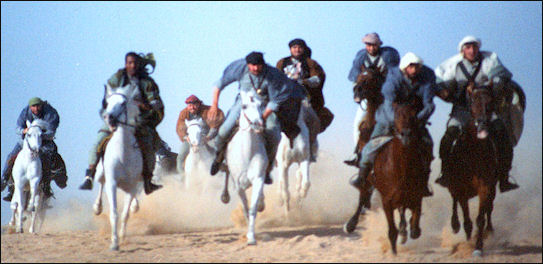
Bedouin raid in a TV drama
Bedouins have nasty blood feuds that sometimes end in murder. Describing a revenge killing in southern Arabia in 1946, Wilfred Thesiger wrote: "Bin Mautlauq spoke of the raid in which young Sahail was killed. He and fourteen companions had surprised a small herd of Saar camels. The herdsmen had fired two shots at them before escaping, on the fastest of his camels, and ane of these shots hit Sihail in the chest. Bakhit held his dying son in his artillery as they rode beyond the plain with the seven captured camels. It was tardily in the morn when Sahail was wounded, and he lived till near sunset, begging for h2o which they had no t got." " [Source: "Eyewitness to History", edited past John Carey, Avon, 1987]
"They rode all night to a small-scale Saar encampment under a tree in a shallow valley. A woman was churning butter in a skin, and a male child and girl were milking the goats. Some minor children sat under a tree. The boy saw them first and tried to escape but they corned him confronting a low cliff. He was about fourteen years erstwhile, a trivial younger than Sahail, and unarmed. When they surrounded him he put his thumbs in his mouth equally a sign of surrender, and asked for mercy. No one answered him."
Bakhit slipped ain off his camel, drew his dagger, and drove it into the boy'southward ribs. The male child collapsed at his anxiety, moaning, 'Oh, my father! Oh, my begetter!' and Bakhit stood over him till he died. He then climbed back into his saddle, his grief a piddling soothed by the murder...The small, long-haired figure, in white loincloth, crumpled on the ground, the spreading puddle of blood, the avid clustering flies, the frantic wailing of the dark-clad women, the terrified children, the shrill ceaseless screaming of a small baby."
Bedouin Food

Typical Bedouin food includes bread, rice dates, seasoned rice, yoghurt and milk and meat from their animals. Bedouins like to eat goat-and-rice dishes cooked over an open fire. A typical Bedouin breakfast consists of yoghurt, bread and coffee. Nomads have traditionally sold their animals and used the money to buy bags of wheat, rice, barely, salt, coffee and tea, which are carried by their animals.
Bedouin bread is made by women who flatten balls of dough into flat sheets and places them in a rounded stove for baking. Bread can also be baked in the sand or cooked over a bivouac in a metal dome.
Dates are the staple of the Bedouin nutrition. They are harvested from palm trees and stale out in the sunday and stored for the winter when they supply food for a family and sometimes for camels, goats and sheep. Bedouin can go for months, subsisting on nothing merely dates, animal milk and h2o. Sometimes when swarms of locusts arrive they are collected, roasted and eaten. Some are dried and crushed into pulverization and stored. Animals are usually simply slaughtered for feasts and celebrations.☼
Bedouins have traditionally eaten rice and meat with their fingers while sitting on the ground or floor. When meat is eaten oftentimes a large chunk is passed around and everyone cuts of a piece with their dagger. Cooking has traditionally been washed outside on camel dung campfires by women. The fire is made in a pit with 3 stones used as a back up for the cooking pot.
Describing a Bedouin banquet, Thomas Ambercrombie wrote in National Geographic, "Hardly a discussion was spoken...Nosotros ate busily, thrusting our right easily into the pilaf, squeezing the rice into seize with teeth size lumps and popping and so into our mouths. The choicer tidbits — lungs, kidneys, an brain — the sheik tore out and laid earlier his guests. A immature male child brought a dish of dates and bowls of fresh camel milk." Bedouins frequently indicate that a banquet is over by licking their fingers and then leave to wash and return for fruit or desert.
Bedouin Potable and Hashish

Western idea of a Bedouin beauty Bedouins like to beverage thick, gritty coffee traditionally fabricated from green beans crushed in a brass mortar and spiced with cardamom, and sometimes ginger root. Out in the desert the coffee is brewed with water boiled over a brush wood fire and poured from a long-beaked brass pot into porcelain thimble-size cups or pocket-sized cups that wait like egg cups.
Coffee breaks are relished. They are the primary social activities. They are usually exclusively male affairs and sometimes last all solar day. If a stranger is spotted on the horizon a pot of coffee is brewed to offering with dates as hospitality when they arrive. A guest customarily accepts 3 servings. Bedouins indicate they take had enough to drink by twisting the cup back and forth with their wrist. Coffee has traditionally been one of the most popular backsheesh gifts.
Bedouin "kahwa" is a stiff aromatic java made with cardamon pulverization, saffron and rosewater. The java beans are roasted over a camel dung burn down so basis. After a pinch of cardamon is added the coffee is brewed in a long cervix brass pot. Some Bedouin slike Arabic coffee spiced with ginger and filtered with a layer of dried grass.
Bedouin also drink tea. Describing a Bedouin tea anniversary Abercrombie wrote: "Ahmad cracked a tall cone of difficult carbohydrate and popped a fist-size clamper into the hot tea forth with handfuls of mint leaves, He poured himself a sip, sampling it with all the concern of a french wine taster. Some other chink of sugar and it was perfect. He filled our glasses with the mash thick and sweet every bit syrup. "Bismillah," the sheik intoned before nosotros drank. "In Allah's proper name."
Bedouins often consume frothy camel milk communally from an aluminum basin. Explaining the attraction of the warm and sweet camel milk direct from the fauna, one Omani Bedouin told National Geographic, "This is fresh as information technology gets. Makes everything digest. Nosotros drink it all the time."
Some Bedouins smoke hashish. Mickey Hart, the drummer in the Grateful Dead, who spent some time with Bedouins in the Sinai, said he had to smoke the "heroic" amounts of hashish to get in good plenty graces with his host to record some of their music.
Bedouin Dazzler and Hygiene
Men, women, children and infants in Bedouin tribes decorate their eyes with kohl as the ancient Egyptians did. Some Bedouin women take geometric facial tattoos and henna-stained patterns on their calloused hands. Young Bedouin girls brainstorm tying coins in their hair before their forepart teeth have grown in.
With water in brusque supply, Bedouins don't take many baths. Earlier prayers they frequently wash with sand rather than scarce water. Bedouins wash their pilus with powdered leaves of the sidr tree, a thorny fruit tree also know every bit Christ'due south thorn because it believed to accept been used to brand Christ's crown of thorns. The leaves are stale and pounded and mixed with water to brand a lather.
Bedouin Wearing apparel

Bedouin sword dance Sun and sand protection is the primary objective with Bedouin clothes. Bedouin garments can be wrap around the wearer to keep the sand and sun out. Loose clothing tends to shield the skin from lord's day and provide enough open up space that heat absorbed past the cloth is not directly transferred to the skin.
Each Bedouin tribe member wears slightly clothes to indicate locality, social position and marital status, with these things commonly existence indicated by embroidery on their cloak, headdresses, jewelry and hairstyle worn on special occasions. Each tribe has is ain designs that are worn on their clothes, Tents and camels bags besides comport these designs and then that caravans tin be identified from a altitude.
A typical Bedouin human being habiliment a white cotton foot-length, long-sleeve shirt, an "aba" (a long khaki ankle-length sleeveless robe), and red tasseled sash. Sometimes they wear a dagger in their chugalug. At night the aba is used a blanket. In many places Bedouin men wear a "thobe" (a long white gown). Sometimes they wear a long sleeve glaze called a "gumbaz" or kibber" over the thobe.
Bedouin men tend to habiliment camel hide sandals, ankle boots or Western-mode shoes. Some become barefoot in the hot sand. To make standing in the hot sand bearable sometimes they stand on one and then alternate back and forth with the other foot. If they step on a thorn they use another thorn to dig information technology out.
On their head Bedouin men habiliment a Yasser-Arafat-way "keffiyeh" , which tin exist draped under the chin, lifted across the face for protection against sandstorms, or crossed nether the chin and stock-still on pinnacle of the head for warmth. The cloth headdress held in identify by a thick wool cord of made of blackness goat pilus. When it is cold he may wear a round wool cap nether the a "keffiyeh" .
Women article of clothing dark clothes and a kerchief held in place with a band of folded cloth. Red is usually worn by married women while blue is worn by unmarried women. Loose cloaks, or "thobe" , are worn for special events. These frequently feature embroidery around the neckline, sleeves and hems. Veils are often connected to a turban and are busy with silverish coins. Everyday clothes are much plainer. Bedouin women usually clothing sandals.
Some Bedouin women wearable a "niqab , a mask-like veil that reveals only the optics and cervix and has a narrow ridge that runs down the middle of the face. The veil goes beyond the face. The minor connecting slice near the bridge of the nose is useful for Bedouin women, when riding camels or doing other activities equally information technology prevents their garb from falling down or off. For a woman wearing such a garment simply immediate relatives are immune to see her face up. Bedouin women in Kingdom of saudi arabia wear a black tent-like cloak over their apparel and a mask that covers the entire faces except for modest optics slits. In the desert most Bedouin women don't clothing veils because they are is merely too hot. They don them when strangers appear.
Bedouin Music, Entertainment and Culture

At night Bedouin like lay a rug o the sand and set and campfire and drink tea and camel milk late into the dark. When travelers are around they are invited to share a coffee. Travelers prove they have had enough java by shaking their cups.
Traditionally Bedouin civilisation includes traditional music, poetry, dances (like Saas), Festivals characteristic various Bedouin traditions such as poetry recitation, traditional sword dances, traditional tent knitting and performances of traditional Bedouin musical instruments. Camel riding and camping in the deserts are also popular leisure activities among urbanised Bedouins who live most the desert. [Source: Wikipedia]
Bedouin music features a prominent clarinet, distinctive Bedouin rhythms and chanting. Around a campfire Bedouins may chant songs well into the nighttime. "Al-Huda" is caravan chants were devised to help camels have their minds off their heavy loads. According to one story the songs were and then effective that the camels would arrive a the destinations lively and full of strength but when the singing and drumming stopped the dropped dead from fatigue.
Bedouin instruments include drums, single cord instruments and recorder-like wind musical instrument. A Bedouin musical instrument which dates Biblical times is the "kinnor" .☼
Sheep wool and goat hair is woven into tents, carpets and blankets by women. Important artistic expressions of design, color and patterns is incorporated into these handicrafts.
Bedouin Literature and Poetry
Oral verse was the near pop fine art class among Bedouins. Having a poet in one's tribe was highly regarded in society. In addition to serving as a class of art, verse was used as a means of conveying information and social control.
Bedouins produce poetry and value oral skills among both men and women. Bedouin poems include advice to children, messages to lovers and enemies, self-deprecating dances, accounts of battles, and accounts of historical events. These poems have traditionally been recited effectually campfires at night along with folk tales and stories from Koran that sometimes give Mohammed supernatural powers,
Bedouin poems are often unique to the tribe, with tribes only a few kilometers away not knowing the verses of their neighbors. Since Bedouins were illiterate until relatively recently, their poetry, literature, history and traditions were passed on orally from one generation to the next.
Volume: "Bedouin Poetry of the Sinai and the Negev" by Clinton Bailey (Clarendon Press, Oxford University)
Bedouin Education and Health

Some Bedouins can not read or write and have never spent a mean solar day in a school. However, Shamika A. Mitchell, Ph.D. of Rockland Community College, Country University of New York, said: "It is widely known that Muslims are required to larn the Qur'an" and since "the majority of Bedouins are Muslim there is a likelihood that literacy (at least for men & boys) is somewhat normal." It is possible that "they don't learn to read the Qur'an, and that they learn through oral memorization."
Bedouins that are 35 to twoscore ofttimes await 50 or lx, a issue of a hard life and exposure to the sun and dry air. Illness is attributed to imbalances of elements, the presence of evil spirits and germs.
A doctor who worked with Bedouins told National Geographic, "The most common problem is respiratory infection, because they live outside without proper housing in the wintertime. And their diet is by and large milk, meat, rice, some bread, and dates — no fresh fruit or vegetables."
Treatments include modern medicine, herbal remedies, branding and the wearing of amulets, often with Koranic scriptures inside. Bedouins with centre trouble are sometimes treated with cigarette burns to the chests, a mutual folk remedy. Some Bedouins receive medical intendance from doctors that visit remote regions by plane. ☼
Image Sources: Wikimedia Eatables, The Louvre, The British Museum
Text Sources:"History of Arab People" by Albert Hourani (Faber and Faber, 1991); "Islam, a Short History " past Karen Armstrong (Modern Library, 2000); National Geographic articles about the Middle East; New York Times, Washington Post, Los Angeles Times, Times of London, Yomiuri Shimbun, The Guardian, The New Yorker, Time, Newsweek, Reuters, AP, Solitary Planet Guides, Compton's Encyclopedia and diverse books and other publications.
Last updated February 2019
angelesthestaters.blogspot.com
Source: https://factsanddetails.com/world/cat52/sub331/item1988.html
0 Response to "What Was the Importance of Art Literature Poetry in Bedouin Society Ap World History"
Enviar um comentário